Date:12/8/25
Today's fish of the day is the Pacific sleeper shark!
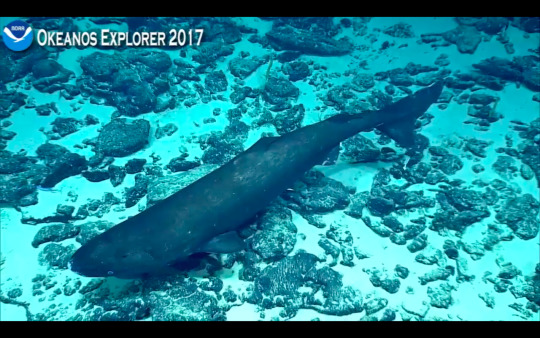
The Pacific sleeper shark, scientific name Somniosus pacificus, is known for their sluggish demeanor, and unique look. Named not only for their behavior, but for the small fins, making it harder for the to thrash when caught by humans. These sharks can be found around the continental shelf of the Pacific, spanning from the Southern coasts of Japan across the Northern Pacific down to the coasts of Baja Mexico. Although they can be found trapped in intertidal areas, as they are incapable of escaping strong tides. This may be why these sharks are often found in deeper waters as they age, from 2000 meters and below once they reach sexual maturity.
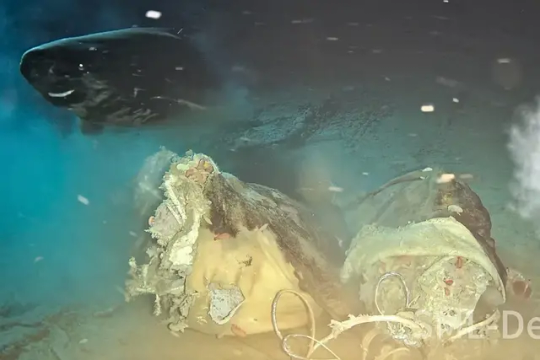
Despite their pacific sleeper sharks' slow nature, they can reach a regular size of 3.7-4.3 meters, with a maximum size of around 7 meters. These sharks have lower teeth specialized for slicing, and upper teeth used for spearing and trapping prey. These teeth are used, as these sharks hunt via suction, before slicing into their caught prey. These sharks act as stealth predators, waiting until small prey crosses close. The sleeper shark preys on small surface and bottom dwelling animals, such as: seals, various fish, octopi, and whales. Pacific sleeper sharks in particular have the ability to roll the eye backward in its socket, lacking a nictitating membrane to do so, a relatively common adaptation in the genus of sleeper sharks. This is to protect against the thrashing of prey as the shark feeds. They are not often predated on, as their flesh is toxic to humans and incites symptoms of drunkenness.
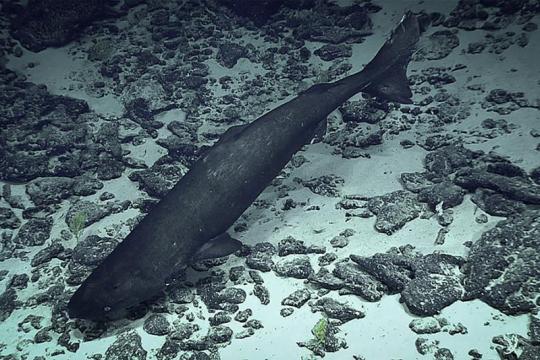
Like many other deep dwelling sharks, the Pacific sleeper shark's reproduction and lifecycle isn't very well known. Like most other sharks, they are ovoviviparous, having eggs inside the mother until they are ready to hatch. Mothers can be found with as many as 300 eggs per breeding season, although only a maximum of 10 will be born. These juvenile sharks come into the world at a size of 42cm or less. However, there is no knowledge on defined breeding season, time of gestation for fry, any possible courtship behaviors, or lifespan. This is likely due to their deep environment, and inability to be eaten.
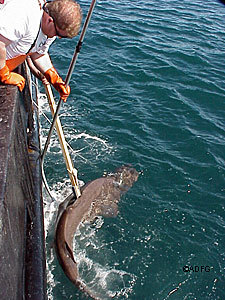
That's the Pacific sleeper shark, everybody! I hope you enjoyed getting to read about them, and have a wonderful Monday!
Pacific sleeper shark - Somniosus Pacificus. Shark Research Institute. (n.d.). https://www.sharks.org/pacific-sleeper-shark-somniosus-pacificus
Somniosus Pacificus summary page. Fishbase. (n.d.). https://www.fishbase.se/summary/Somniosus-pacificus.html
Matta, M. E., Tribuzio, C. A., Davidson, L. N. K., Fuller, K. R., Dunne, G. C., & Andrews, A. H. (1970, January 1). A review of the Pacific Sleeper Shark somniosus pacificus: Biology and fishery interactions. Welcome to the NOAA Institutional Repository. https://repository.library.noaa.gov/view/noaa/65736
Carroll, A. (2005, May). Sleeper Sharks: Awake and Hungry. Alaska Fish and Wildlife News. https://www.adfg.alaska.gov/index.cfm?adfg=wildlifenews.view_article&articles_id=146