Date:Wed 5/22/2024 8:00 AM
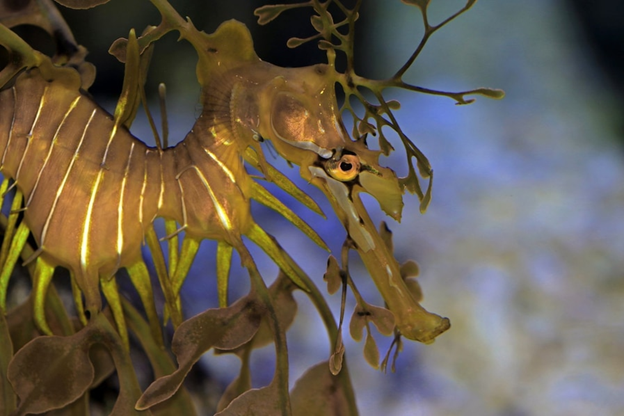
Happy Wednesday, everyone! Today's fish of the day is the leafy sea dragon!
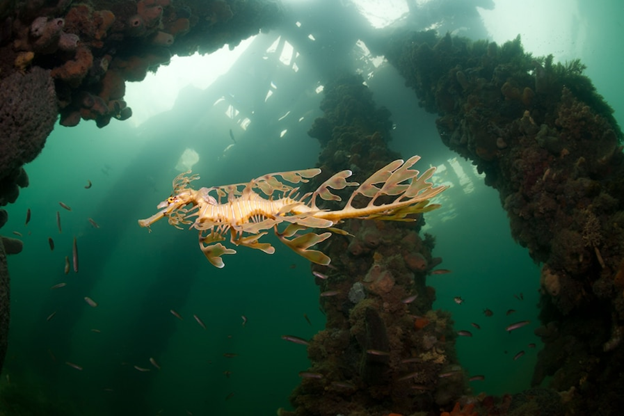
The leafy seadragon, also known as "Leafies", and Glauert's seadragon, scientific name Phycodurus eques, is known for their unique camouflage! Originally thought to exist in small and interspersed populations, it is now known that they are widespread, and can be found on the Southern and Western coast of Australia, these fish are native to kelp beds and other grassy areas, although they can also be found in sandy patches. They prefer areas at depths more than 50 meters below the surface, and this is where they reside close to the seafloor.

Like others in the Syngnathinae family (Pipefishes, seahorses, and seadragons), leafy seadragons have incredibly poor swimming skills. They swim via quick movements form the dorsal fin, and although pipefish have the aid of a caudal fin, seahorses and seadragons have no such luck. Seadragons also lack the prehensile tails that is associated to their seahorse cousins, leaving them only with camouflage to aid their survival. The leafy seadragon diet is made up of tiny planktonic crustaceans called mysid shrimp. These shrimp are caught by sucking them into the mouth of the fish, and they have advanced enough eyes to hunt them. They can get as large as 20 inches, but most only get about as large as 12inches on average.
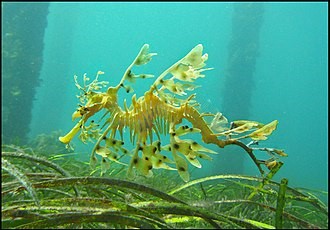
Mating in leafy sea dragons is very similar to the mating of seahorses. Females will lay up to 250 eggs in a single breeding season, and these eggs will be held by the male. However, unlike seahorses, seadragons do not have a specialized pouch for incubating their children, but rather male seadragons hold their eggs underneath their tail in a brood patch, which protects and aerates the eggs. In about 4 weeks these eggs will be ready to hatch, a process that takes around 24 hours, where the father helps by shaking the tail to help dislodge. After this the babies will be only 20mm large, and survive independently, hunting zooplankton. Seadragons grow quick though, reaching 8 inches in their first year of life. After this they will then reach their full adult size by their second year, when they also reach sexual maternity. They will then live a full life of 5-7 years.
I hope everyone has a wonderful Wednesday!