Date:Wed 6/26/2024 1:00 PM
Happy Wednesday, everyone! Today's fish of the day is the Pelagic thresher!
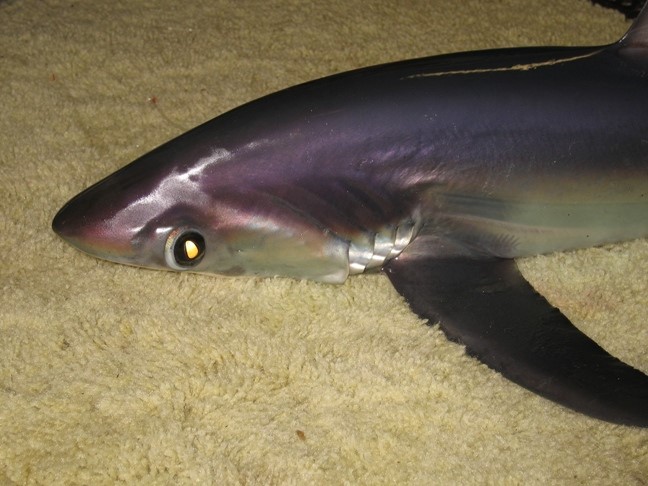
The pelagic thresher, also known as the pacific common thresher shark, scientific name Alopias pelagicus, is a common thresher shark. Found along the tropical and subtropical waters in the Pacific and Indian ocean, stretching from South Africa to The West Coast of America. Like other thresher sharks, the pelagic thresher inhabits the open ocean, occasionally coming close to the continental shelf near coral reefs, and seamounts. Seasonally, they migrate North and South, to follow warmer waters. Pelagic threshers are the smallest species of thresher shark, and despite being visually similar to their relatives they can be differentiated by the dark pigment above the pectoral fins and the rounded fin tips.Similar to other threshers, the teeth are smooth and small, with 20-22 teeth per jaw, curved inward to trap prey inside their mouth.

Due to their medium size, the pelagic thresher is predated on by many larger predators. Primarily larger sharks, orcas, and other toothed whales that share an area. They are known to have tapeworm parasites and copepods in the skin. This leads to the symbiotic relationship with cleaner wrasses, who eat their parasites. The pelagic thresher's diet consists of small prey along the mesopelagic zone, primarily lightfishes, barracudas, flying fishes, herrings, squids, and mackerels. This keeps them from competing with other oceanic predators in their size range, such as tuna, billfish, and other sharks. They hunt similar to other thrasher sharks, by swimming tight circles around a school of prey, until they condense. Then, striking with the upper caudal fin tip lobe of the tail to stun. This long tail is often the cause for plegic threshers getting hooked as bycatch for other fishing efforts, specifically having issues with longlines. Although several commercial fisheries go out of their way to hunt for plegic threshers, leading to their status as endangered.

Just like all other mackerel sharks, the pelagic thresher shark is ovoviviparous, meaning they have young kept in eggs within the mother, and when they hatch, they are born live. Similar to other thresher sharks , the pelagic thresher gives birth to two pups at a time, one per each uterus. They have no defined breeding season and the gestation period is unknown, but assumed to be similar to the year gestation period of common threshers. Pups are born surprisingly large, at about 5 feet in length. As compared to the sexually mature adult size of about 10 feet, the largest recorded being around 11feet. Maturity is reached at around 9 feet in length, which is usually around the 8th or 9th year in females, and around 7-8 years in males. Their lifespan is about 28 years in females, possibly longer, whereas male threshers get the short stick, living only 17 years in comparison.

Have a wonderful Wednesday, everyone!