Date:12/9/24
Happy Monday, everybody! Today's fish of the day is the giant oarfish!
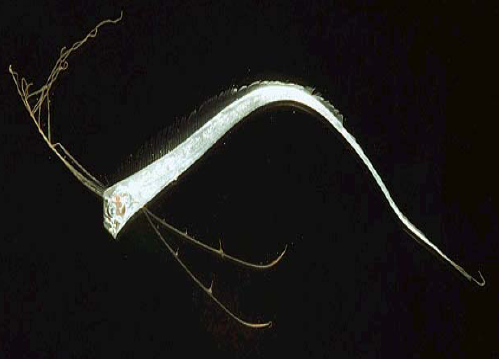
The giant oarfish, scientific name Regalecus glesne, is one of the three surviving oarfish alive today, and the most notable. Oarfish are primarily known for much of the mystery and myth surrounding them, along with their long and irregular shape. Oarfish are the longest bony fish alive, and can grow upwards of 8 meters long, and are believed in Japanese mythology to warn or signify oncoming earthquakes and natural disasters, portraying them as harbingers of doom. There are also conspiracy theories online in spaces dedicated to expressing fear of the ocean that claim that the oarfish which have been observed are only juveniles, and that in deeper waters there may be larger oarfish. Which is untrue, as adult and sexually mature oarfish have been observed.
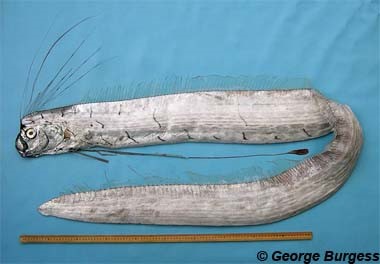
Giant oarfish in particular can be found from as far north as 72°N and as far as 52°S South, but mostly can be found in the tropics, middle latitudes, and around the eqator.It can be found in the Pacific, Atlantic, and Indian oceans, traveling between them following food. This fish lives in both the Epipelagic and mesopelagic zones, thought to be from around sea surface to 1000 meters below surface. although the deepest actually recorded record of giant oarfish is only 492 meters in the Gulf of Mexico. This fish, despite missing and or having significantly reduced pectoral, caudal, and anal fins along with no swim bladder, swims thought undulation of the dorsal fin, often in a vertical position, giving rise to theories that this fish in particular may have been the origin of sightings of "sea serpents" from the depths. This is particularly evident when storm or natural disasters are approaching, as they tend to be found beached before and after large storms.
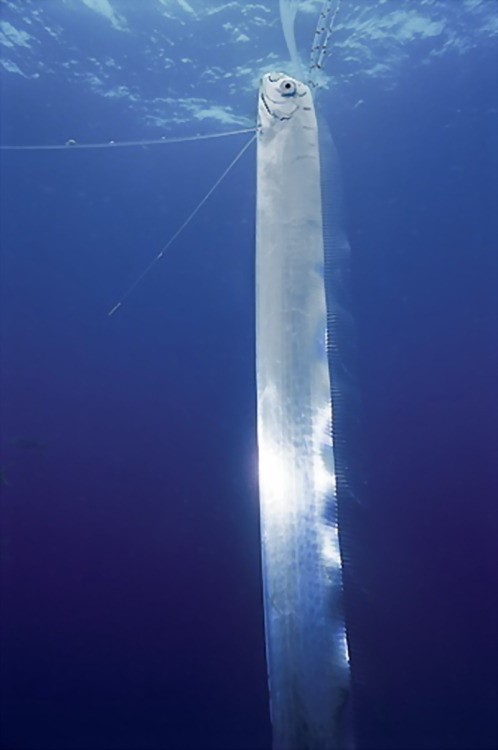
We know very little about the diet of this fish, as almost all living fish captured have empty stomachs or simply colored liquids inside, although some have had krill inside. Regardless of what the diet is made up of, it supports these fish's ability to get upwards of 7-8 meters, with the longest recorded being an entire 26 feet in length. As far as we are aware the giant oarfish has no natural predators, although these fish have been known to self amputate, removing entire meters of their bodies at a time.The organs of the giant oarfish, and oarfish in general are clustered close to the head of the body, with the reminder being made up only of the caudal fin and vertebrae, making it easy for this fish to self amputate without the removal of any organs. This is for reasons we do not currently understand.

The only species of oarfish of which the reproduction is well understood and the model understanding for other species is the giant oarfish. That being that these fish are solitary, meeting only for breeding and spawning. These fish spawn from July to December, breeding for only two months or so individually before leaving the group to return to solitary life. These fish will release eggs and sperm, having multiple breeding events a season after which they abandon the eggs to the water column. These eggs are zooplankton, carried by the currents for around 3 weeks until they hatch and can swim. Very little is known about their lifespan and growth rate, but juveniles spawn with full pelvic fins and a long dorsal fin spanning much of the vertebrae, and that this pelvic fin grows smaller in comparison to the rest of the body as they age.
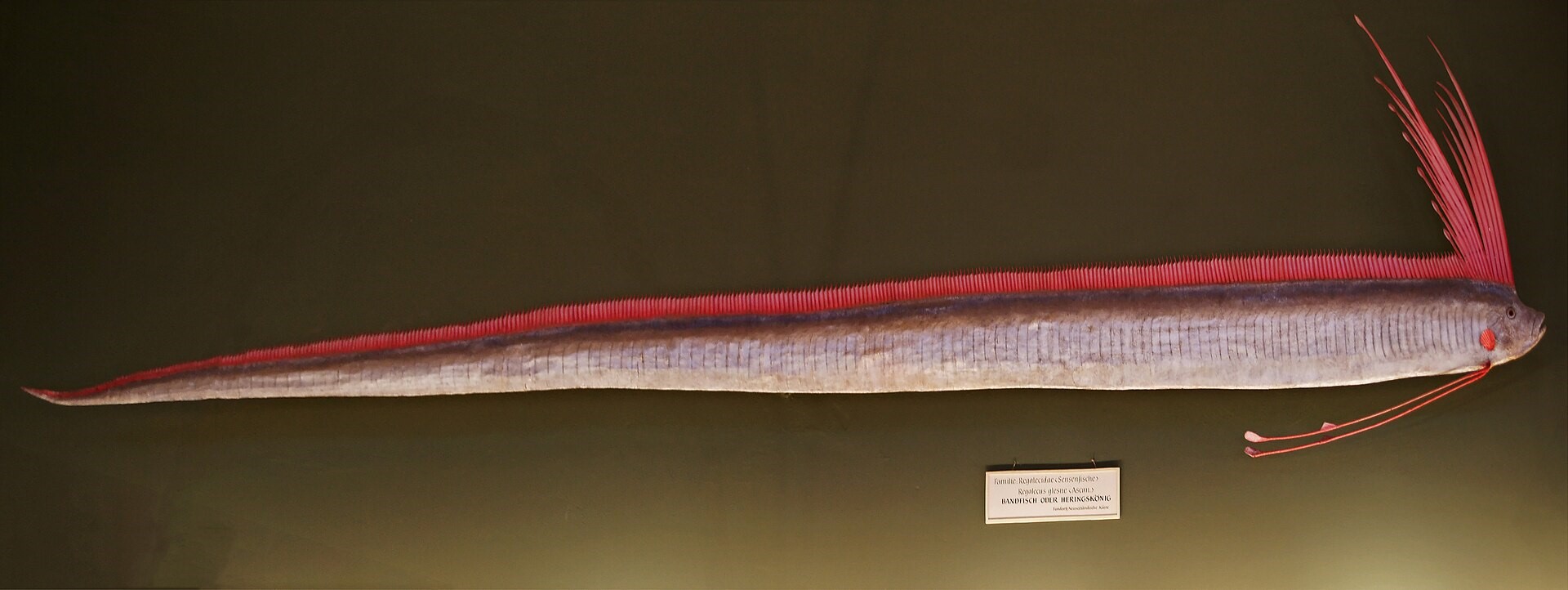
That's all we know about the giant oarfish, and oarfish in general for now! Have a wonderful rest of your Monday!